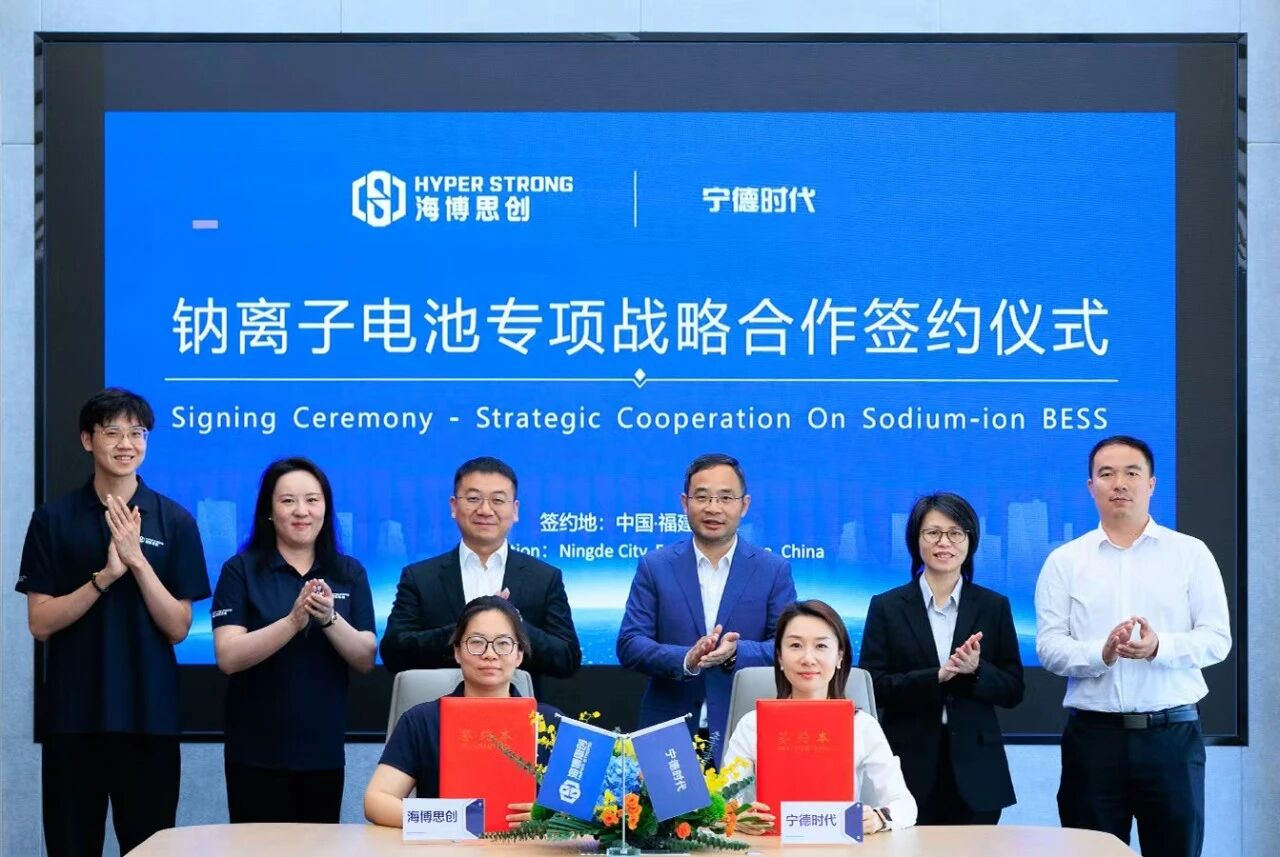
Battery manufacturing giant CATL has signed what is hailed as the world’s largest sodium-ion battery order with Chinese system integrator HyperStrong, the two companies announced on April 27. The three-year partnership covers a total order volume of 60 GWh.
In a press release, CATL stated that the collaboration demonstrates its success in overcoming challenges across the entire mass-production chain of sodium-ion batteries, enabling large-scale delivery capabilities. It noted that the 60 GWh order, the largest of its kind globally to date, marks the start of a new phase in the commercialization of sodium-ion technology.
Since 2016, CATL has invested nearly CNY 10 billion (about $1.5 billion) in sodium-ion battery R&D. The company has enhanced energy density through morphology control and surface modification, and resolved key mass-production challenges in hard carbon anode manufacturing—including foaming and moisture control—using advanced technologies to ensure batch consistency.
At ESIE 2026 in Beijing on April 1, CATL unveiled a new sodium-ion battery for energy storage. A key feature is its platform compatibility with the company’s existing 587 Ah lithium storage cell, sharing the same enclosure dimensions to reduce customer switching costs by aligning with existing system designs, production lines and supply chains.
The large-format battery cell exceeds 300 Ah, with an energy density of around 160 Wh/kg, 97% system energy efficiency, over 15,000 cycles at 80% capacity retention, and an operating temperature range of −40°C to 70°C. It uses a long-cycle hard carbon anode and layered oxide composite cathode, is cobalt-free and nickel-free, and adopts aluminum foil instead of copper foil to cut material costs, with no thermal runaway in safety tests.
Target applications include 2-hour to 8-hour utility-scale storage, shared storage, renewable energy hubs, and data center energy storage.
Sodium-ion technology has long been overshadowed as lithium iron phosphate (LFP) battery cell prices fell to roughly $50/kWh. However, mainstream 314 Ah LFP storage cells have risen about 20% in the past six months due to tight lithium supply and strong demand, making sodium-ion batteries more competitive—with a potential 30-40% cost advantage over LFP as they enter early mass production.