Image: Government of the Ivory Coast
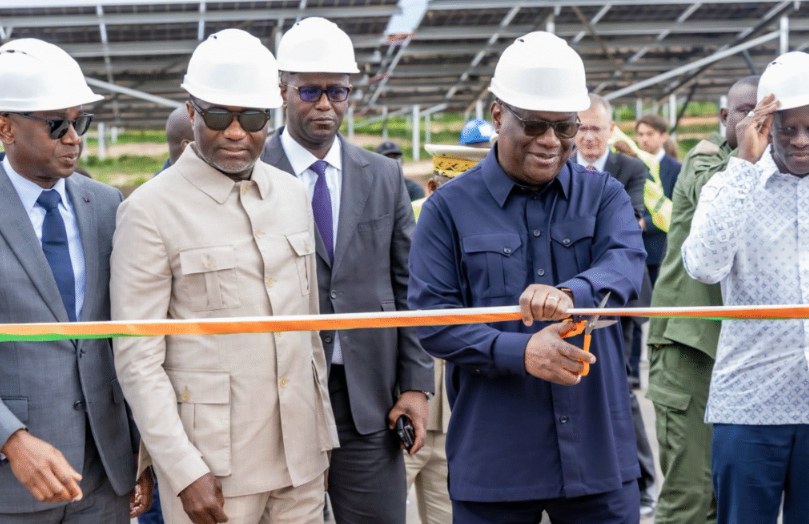
A new 52 MW solar power plant has been officially inaugurated in Ivory Coast’s northern Tchologo region, marking another major milestone in the country’s renewable energy expansion. Known as the Ferké solar power plant, the landmark project advances the nation’s goal of scaling up clean electricity access and strengthening energy independence.
Priced at XOF 41 billion ($71.5 million), the solar facility spans 70 hectares and is equipped with over 73,000 solar panels, capable of generating 90 GWh of electricity annually. The project was initiated in February 2024, when the Ivorian government signed a concession agreement with infrastructure investor PFO Africa.
During the inauguration ceremony, Ivory Coast’s Deputy Prime Minister Téné Birahima Ouattara highlighted the plant’s far-reaching social and economic benefits. The facility will supply stable power to more than 370,000 local households, as well as regional schools, health centers and commercial enterprises. He emphasized that solar energy presents a vital opportunity for the country, serving to cut energy costs, accelerate rural electrification, create youth employment, bolster national energy sovereignty, and drive sustainable, inclusive development.
The Ferké solar plant is the country’s second operational utility-scale solar project, following the commissioning of the Boundiali solar facility in April 2024. Ivory Coast’s solar pipeline continues to expand, with multiple large-scale projects in progress. The 50 MW Kong solar project and 52 MW M’Bengue solar plant are scheduled to come online by the end of 2027, while an additional 50 MW solar scheme is under construction by a subsidiary of the UAE’s Amea Power.
Driven by an ambitious national energy transition roadmap, Ivory Coast aims to lift the share of renewables in its energy mix to 46.3% by 2035, with solar power capacity targeted to exceed 1.3 GW by the same year. Data from the Africa Solar Industry Association (AFSIA) shows the country currently has 660 MW of operational solar assets and a further 199 MW under construction, predominantly comprising commercial and industrial installations.