
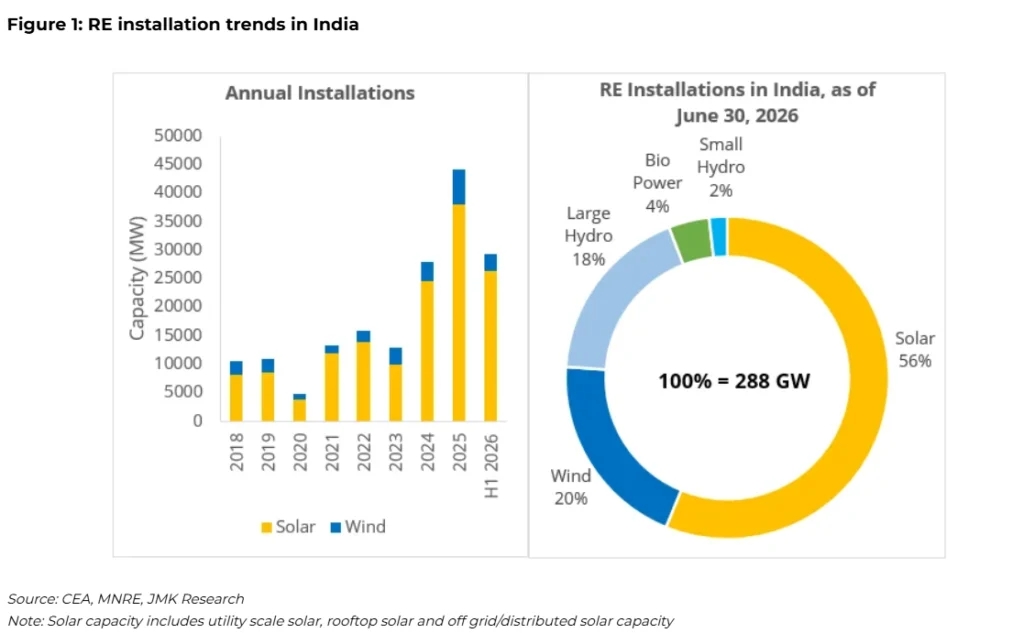
India added 26 GW of solar and 3 GW of wind capacity in the first six months of 2026, marking a 43% year-on-year jump in solar installations while wind additions dipped 16% annually, according to fresh data from energy research firm JMK Research.
H1 2026 solar deployments nearly hit 70% of India’s full-year solar capacity additions in 2025, demonstrating accelerating clean energy rollout. Per official data from the Ministry of New and Renewable Energy (MNRE), India’s cumulative installed renewable capacity stood at roughly 288 GW as of end-June 2026. Solar dominates the mix at 56%, followed by wind (20%), large hydro (18%), bio power (4%) and small hydro (2%).
Utility-scale solar remained the largest growth segment with 19 GW of new capacity in H1 2026, up 32% versus H1 2025. The rooftop solar market delivered standout performance, recording 6.4 GW of new installations — a 104% year-on-year surge. JMK Research attributed this sharp expansion primarily to India’s PM Surya Ghar: Muft Bijli Yojana rooftop solar scheme, which drove most residential rooftop deployments in the period. Off-grid and distributed solar added 842.9 MW, a mild 3% annual rise.
State-level breakdown shows Gujarat, Rajasthan and Tamil Nadu led solar capacity additions in the first half. Gujarat topped the chart with 7.6 GW (29% of national new solar), followed by Rajasthan at 6.6 GW (25%) and Tamil Nadu with 2.4 GW (9%).
JMK Research raised its full-year outlook on the back of robust H1 performance, forecasting combined solar and wind additions of 47 GW across 2026. The sustained expansion puts India firmly on track to hit its national target of 500 GW non-fossil fuel installed capacity by 2030.