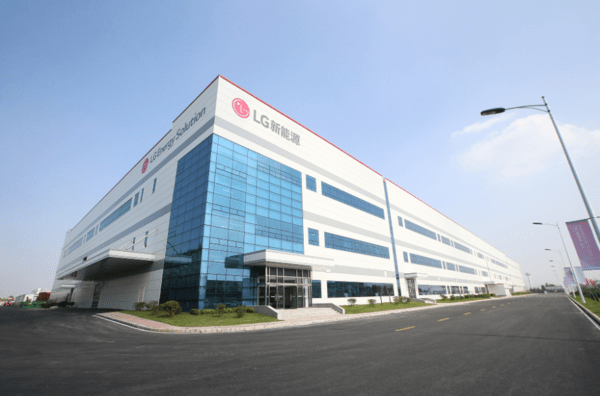
LG Energy Solution is ramping up cylindrical battery production at its Nanjing manufacturing complex to address mounting order volumes from Tesla, driven by robust global sales of the automaker’s Model Y and Model 3 electric vehicles.
Industry insiders confirmed LGES has lifted utilization rates of its existing cylindrical battery lines since late 2025, with all current lines now running at full capacity. To further lift supply capacity, the firm will launch new production lines at LGESNJ Plant 9, its dedicated cylindrical battery manufacturing base in Nanjing.
Staff recruitment for the new lines at Plant 9 has been fully completed, with all workers scheduled to report for duty around July 20. Though the Plant 9 facility was finished two to three years ago, this expansion marks its first official mass production launch. LGES plans to commission two new cylindrical battery lines here in the second half of 2026, with extra lines to be added in subsequent investment phases. Each line delivers an annual capacity of about 2 GWh, and cumulative capacity at the site will expand to double-digit GWh with follow-up investments.
LGESNJ, one of LG Energy Solution’s three Chinese manufacturing subsidiaries, oversees all cylindrical battery production across nine factories distributed at five Nanjing campuses. The new lines at Plant 9 adopt identical manufacturing standards, equipment layout and production workflows as Plant 6, LGESNJ’s most advanced cylindrical battery plant that entered operation in 2019. LGESNJ’s total annual cylindrical battery capacity stands at roughly 50 GWh, 30 GWh of which comes from Plant 6, whose cells are exclusively supplied to Tesla Shanghai Gigafactory.
“A booming cylindrical battery market pushes us to fully leverage our existing factory infrastructure,” a spokesperson for LG Energy Solution stated, declining to comment on specific customer cooperation details.
LG Energy Solution supplies high-performance cylindrical cells for premium Tesla models, including Long Range variants of Model 3 and Model Y, the updated rear-wheel-drive Model 3 launched in 2025, and the six-seat long-wheelbase Model Y L. EVs rolled out from Tesla Shanghai Gigafactory are exported to South Korea, Japan, Australia, Europe and other overseas markets.
Tesla’s Shanghai plant ranks as its largest global production hub, with an annual capacity exceeding 950,000 Model 3 and Model Y units, far exceeding its Berlin (375,000 Model Y/year), Texas (250,000 Model Y/year) and Fremont (550,000 combined Model 3/Y/year) facilities. Data from China Passenger Car Association (CPCA) shows Tesla delivered 378,858 China-made EVs in the first five months of 2026, a 29% year-on-year jump from 292,875 units in the same period of 2025.
Tesla also maintains explosive sales momentum in South Korea. The Model Y became the nation’s top-selling passenger car in May, the first imported vehicle ever to outpace all local domestic models, while the newly launched Model Y L claimed the No.1 spot among imported cars in June, only two months after its local debut. The continuous sales surge of Tesla EVs is set to sustain strong battery shipment growth for LG Energy Solution.
The capacity expansion news follows LG Energy Solution’s release of preliminary Q2 financial results on July 7. The firm posted quarterly revenue of 7.5602 trillion won, representing a 24.8% year-on-year increase, while operating profit fell 77% to 113.3 billion won. Analysts noted that rising cylindrical battery shipments fueled by Tesla demand lifted top-line revenue, yet profitability was dragged down by production line conversion work for North American energy storage system (ESS) batteries and extra costs incurred from lifting factory utilization rates.