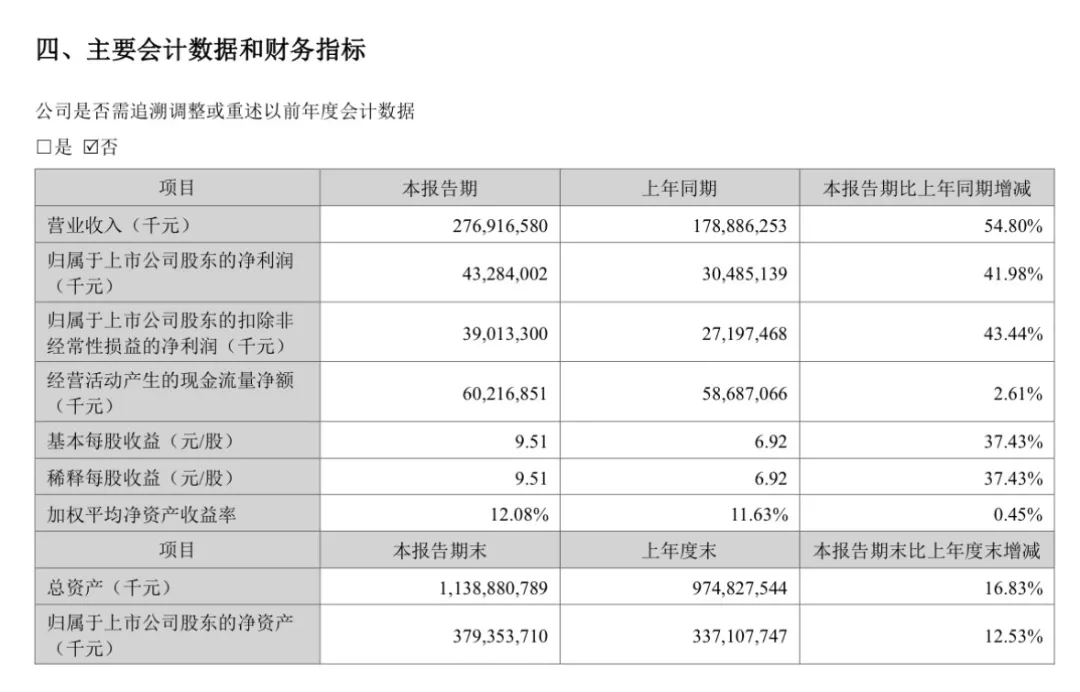
CATL delivered strong revenue and profit growth in the first half of 2026, fueled by surging battery sales and a remarkable 87.5% year-on-year revenue jump in its energy storage system segment, according to the company’s latest financial results.
For the first six months of 2026, CATL achieved a total operating revenue of RMB 276.92 billion, representing a 54.8% year-on-year increase. Its net profit attributable to shareholders rose 42% year-on-year to RMB 43.28 billion, while the adjusted net profit grew 43.4% to RMB 39.01 billion. In terms of cash flow, the company’s operating cash flow edged up 2.6% year-on-year to RMB 60.22 billion. Despite robust shipment expansion, sustained market pricing pressure dragged the company’s overall gross margin down by 1.09 percentage points to 23.93%.
The energy storage battery business emerged as a key growth driver, posting RMB 53.26 billion in revenue, a year-on-year surge of 87.5% and accounting for 19.2% of CATL’s total revenue. The segment registered a gross margin of 23.96%, down 1.56 percentage points yet still outperforming the company’s electric vehicle (EV) battery business. Supported by the strong performance, CATL secured the world’s top ranking in energy storage battery shipments in the first half of 2026, according to data from Chinese research institute ICCSino.
CATL’s core EV battery business maintained its leading position as the company’s largest division, with revenue climbing 46% year-on-year to RMB 192.12 billion. However, intensified industry competition pushed its segment gross margin down 1.78 percentage points to 20.63%. The firm further consolidated its global market dominance, capturing a 40.2% share of the global EV battery market in the first five months of 2026, up 2.2 percentage points year-on-year.
Other upstream businesses also delivered solid growth. The battery materials, recycling and mineral resources segment recorded RMB 18.81 billion in revenue, a 67.2% year-on-year increase, with its gross margin improving significantly by 5.81 percentage points to 27.04%, becoming the highest-margin business segment for CATL.
Benefiting from booming market demand, CATL maintained high-capacity operation in the first half of the year. The company’s existing battery system capacity stood at 525 GWh, with another 764 GWh of capacity under construction. It achieved a first-half output of 498 GWh and a capacity utilization rate of 94.86%, reflecting near full-capacity operation of its current production bases.
Overseas business continued to expand rapidly with higher profitability. CATL’s overseas revenue increased 42.4% year-on-year to RMB 87.13 billion, making up 31.5% of total revenue. Notably, the overseas gross margin reached 29.97%, far exceeding the domestic gross margin of 21.16%. To further strengthen global layout, the company is advancing localized manufacturing projects in Hungary, Spain and Indonesia on the basis of its existing German production base. Meanwhile, CATL ramped up R&D investment, with research and development spending rising 12.7% year-on-year to RMB 11.38 billion in the reporting period.
In terms of capital returns and corporate governance, CATL unveiled two major plans. The company proposed a share repurchase program ranging from RMB 20 billion to RMB 40 billion for its Shenzhen-listed stocks. The repurchased shares will be cancelled to reduce registered capital, marking the largest single share buyback program in China’s A-share market to date, which is pending shareholder approval. Additionally, CATL plans to distribute an interim cash dividend of RMB 14.11 per 10 shares, with a total dividend of approximately RMB 6.49 billion, equivalent to 15% of its first-half net profit.