Image: SNE Research
Global lithium-ion energy storage system (ESS) shipments hit 461.3GWh in the first half of 2026, jumping 71% year-on-year from 269.7GWh, according to the latest industry data released by SNE Research. The report marks two landmark shifts in the global energy storage landscape: non-China markets captured over half of worldwide shipments for the first time, and residential ESS recorded a 128% surge to account for more than 10% of total shipments.
China stays the world’s largest standalone ESS market with 202.5GWh of shipments, representing a 49% year-on-year increase. However, faster expansion across overseas territories reshaped the regional balance. Aggregated shipments to North America, Europe and other global markets reached 258.7GWh, making up 56% of global volume and surpassing the 50% threshold for the first time.
China’s market share consequently declined from 50.5% in H1 2025 to 43.9% in H1 2026. The “Other Regions” segment delivered the steepest growth at 119%, driven by large-scale energy storage projects launched in the Middle East and Australia, while North America and Europe posted 83% and 74% growth respectively.
From an application perspective, grid-scale ESS remains the dominant segment at 347GWh (75.2% of all shipments), rising 69% year-on-year. Residential storage emerged as the fastest-growing track, with shipments more than doubling from 20.9GWh to 47.7GWh (+128%), lifting its overall market proportion from 7.7% to 10.3%. Commercial & industrial (C&I) ESS also registered solid 59% growth, reaching 39.6GWh. Stricter trade policies and localised supply chain rules in North America and Europe have broadened vendor evaluation metrics: besides pricing, supply chain resilience, local manufacturing capacity and regulatory compliance have become critical benchmarks for project developers when selecting ESS suppliers.
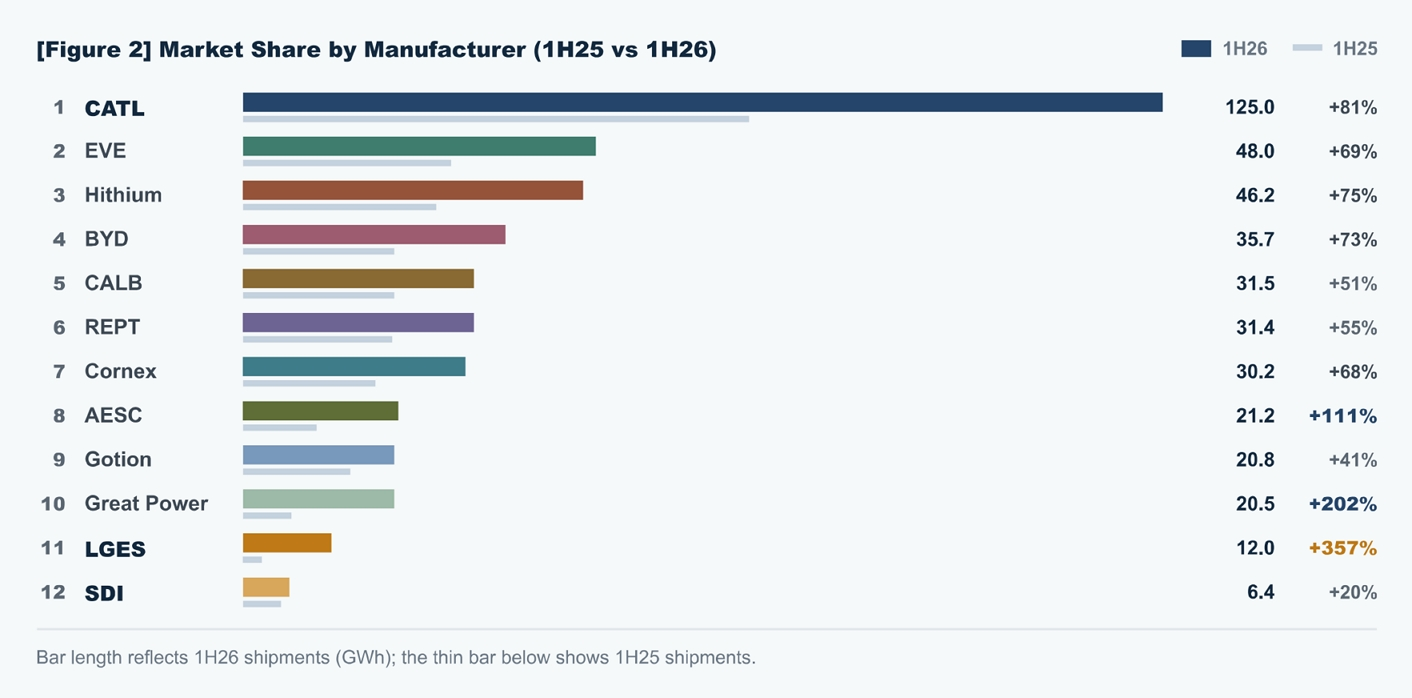
All major battery manufacturers achieved shipment growth in H1 2026, with performance gaps largely determined by their overseas footprint and end-market layout. CATL led the global ranking with 125GWh shipments, lifting its market share from 25.6% to 27.1%, backed by consistent domestic demand and wins in international grid-scale storage tenders. CALB and Gotion High-Tech expanded volumes yet underperformed the industry’s 71% average growth, losing 0.9 and 1.0 percentage points of market share respectively. Companies with established overseas presence outpaced the market average: Great Power saw 202% growth, LG Energy Solution rocketed 357%, and AESC rose 111%.
- Grid-scale ESS: The top five suppliers (CATL, Hithium, EVE Energy, BYD, CALB) control around 69% of the segment. CATL holds a 30% leading share, followed by Hithium at 13%. Upcoming large project tenders in H2 2026 are poised to reshape market rankings in this space.
- C&I ESS: CATL leads with a 35% share, with REPT BATTERO in second place at 14%. The two firms together supply nearly half of global C&I storage demand, and the segment features the most fragmented supplier pool among three tracks.
- Residential ESS: The most concentrated submarket; REPT BATTERO maintains top spot at 32%, alongside EVE Energy (25%) and Great Power (23%). The top three manufacturers capture 80% of residential ESS volume, fueled by rebounding household storage demand across Europe and rising residential adoption in China.