
Europe’s battery energy storage market achieved a new milestone in 2025, with annual installations reaching 36 GWh, a 48% year‑on‑year increase, according to the European Battery Market Outlook 2026‑2030 published by SolarPower Europe. Total operational battery storage capacity across the continent surpassed 100 GWh for the first time, with utility‑scale projects driving the bulk of new deployments.
Utility‑scale batteries accounted for more than half of 2025 additions, hitting 19 GWh compared with 9.7 GWh in 2024. Growth was fuelled by rising demand for grid flexibility, improved revenue‑stacking opportunities, falling technology costs, more solar‑battery hybrid projects and greater investor confidence. Residential plus commercial‑industrial storage combined posted a 16% year‑on‑year rise.
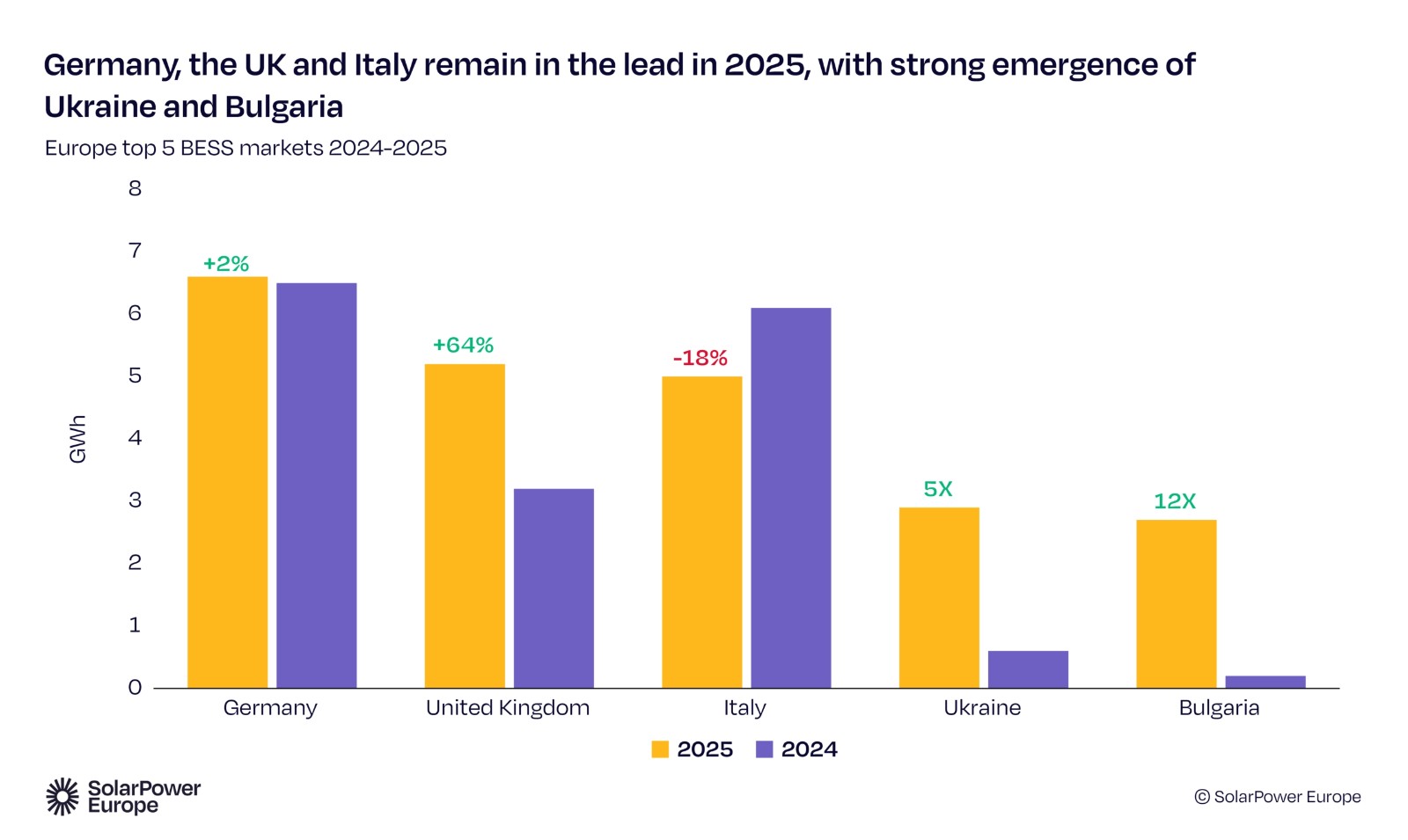
Germany retained its position as Europe’s largest storage market with 6.6 GWh of new BESS capacity despite only 2% annual growth. The United Kingdom ranked second at 5.2 GWh (+64% year‑on‑year), followed by Italy with 5 GWh. Ukraine and Bulgaria broke into the top‑five markets for the first time. Ukraine’s new installations surged roughly five‑fold to 2.9 GWh, while Bulgaria added 2.7 GWh in 2025. Collectively, the top‑five markets represented 62% of Europe’s total deployments, down from nearly 80% in 2024, signalling broader geographic market expansion.
“Ukraine is proving that batteries are more than an energy technology; they are a resilience technology,” said Vladyslav Sokolovskyi, chairman of the board of the Solar Energy Association of Ukraine (SEAU). “Our market is also structurally different from the rest of Europe, and that difference sits in the distributed segment. Across Europe, a home battery is typically bought to optimize electricity bills and store rooftop solar power. In Ukraine, it is bought to keep the lights on.”
Walburga Hemetsberger, CEO of SolarPower Europe, noted that while Europe’s battery storage market is moving in the right direction, progress needs to accelerate to meet the EU’s 2030 target of 200 GW of storage capacity. Under SolarPower Europe’s projections, annual new battery installations will exceed 50 GWh in 2026.
By 2030, yearly additions could range between 99 GWh and 179 GWh, lifting Europe’s total installed storage fleet to 437‑735 GWh. The association calls for removing permitting and grid‑access barriers, securing stable investment frameworks and leveraging EU‑level instruments to scale deployments.