
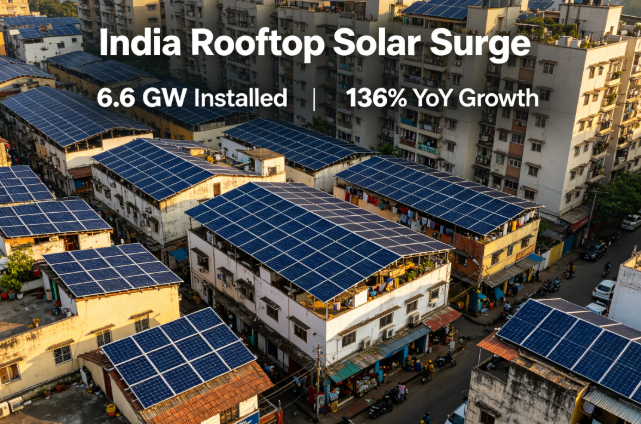
India’s rooftop solar market registered explosive growth in the first half of 2026, with cumulative installations reaching 6.6 GW, a staggering 136% year-on-year jump from 2.8 GW recorded in H1 2025, according to the latest Q2 and H1 2026 India Rooftop Solar Market Report released by Mercom India.
On a quarterly basis, the country added 3.8 GW of rooftop solar capacity in Q2 2026, marking a 41% increase from 2.7 GW in Q1 2026 and a 136% year-on-year rise against 1.6 GW in Q2 2025. Rooftop solar accounted for 33% of India’s total solar installations in the second quarter, solidifying its pivotal role in the nation’s renewable energy expansion.
The robust growth is primarily driven by India’s flagship residential solar scheme, the Pradhan Mantri Surya Ghar Muft Bijli Yojana (PM Surya Ghar program). As of June 2026, rooftop solar systems had been deployed across nearly 4.5 million households, covering 45% of the initiative’s 10-million-household installation target.
Residential segment dominated the rooftop solar market in Q2 2026, contributing 84% of total new installations. Industrial installations followed with a 10% share, while commercial and government sectors accounted for 5% and 1% respectively. Most capacity additions in the quarter were completed under the capital expenditure (capex) model.
The implementation of the second phase of the Approved List of Models and Manufacturers (ALMM List-II) starting June 1, 2026, initially created supply pressure on domestic solar cell availability and pushed up prices of modules meeting Domestic Content Requirement (DCR). To mitigate market disruptions, transitional regulatory measures were introduced. Eligible net-metering and open-access projects are granted a transition window until December 31, 2026. Additionally, residential beneficiaries under the PM Surya Ghar program who opt out of subsidies (“Give It Up” category) are permitted to deploy non-DCR modules until the scheme concludes in March 2027.
Raj Prabhu, CEO of Mercom Capital Group, shared insights on the market’s outlook and challenges. He noted that India holds a strong residential rooftop solar project pipeline, yet actual capacity delivery hinges on accelerated approval procedures, improved financing accessibility and efficient project execution. While rising grid tariffs will bolster commercial solar demand, higher system costs and regulatory hurdles may constrain industrial segment growth.