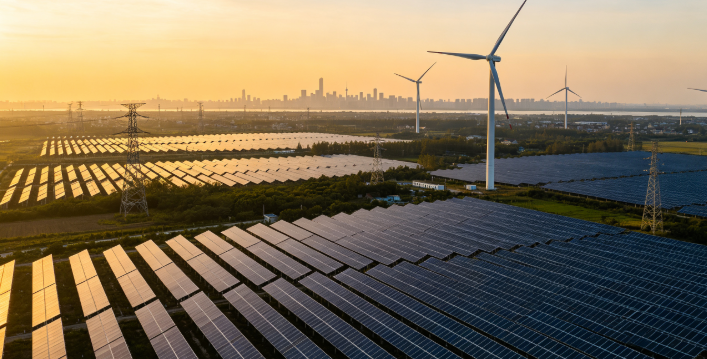
China has achieved a historic energy transition milestone, with solar photovoltaic (PV) capacity overtaking coal to become the country’s largest installed power generation source, official data confirmed. This marks an end to coal’s century-long dominance as China’s primary power capacity source and reshapes the landscape of the world’s largest electricity system.
According to statistics released by China’s National Energy Administration (NEA) on September 1, China’s cumulative solar PV installed capacity hit 1.286 terawatts (TW) by the end of July, marginally exceeding the 1.285 TW of coal-fired capacity nationwide. Solar power now accounts for approximately 31.5% of China’s total installed power capacity, including 704 GW of utility-scale PV and 582 GW of distributed solar installations.
This landmark crossover follows two critical energy milestones in recent years: China’s total renewable energy capacity surpassed coal capacity in 2023, and the combined installed capacity of wind and solar power overtook thermal power in 2025. By the end of July 2026, the country’s overall installed power generation capacity reached 4.078 TW. Other major power sources include 687.2 GW of wind power, 455.5 GW of hydropower, 66.14 GW of nuclear power and 47.91 GW of biomass power. The total installed thermal power capacity, covering coal, gas and other thermal generation, stood at 1.581 TW.
Industry insiders stressed the milestone applies only to installed capacity rather than actual power generation. In the first seven months of 2026, China’s solar power generation reached 802.4 TWh, a year-on-year increase of 15.5%, accounting for roughly 13% of the country’s total electricity consumption. Coal-fired power still dominates actual power output, generating around 2.5 PWh in the first half of 2026 and making up 49.7% of the nation’s total power generation.
Liu Zhiqiang, Deputy Director of Planning and Development at the China Electricity Council (CEC), hailed the shift as a pivotal milestone in China’s green and low-carbon energy transition. He also noted that solar power’s inherent intermittency and lower utilization hours mean coal-fired power will continue to play a vital role in supporting the stability and reliability of the national power system in the near term.