Image:InfoLink
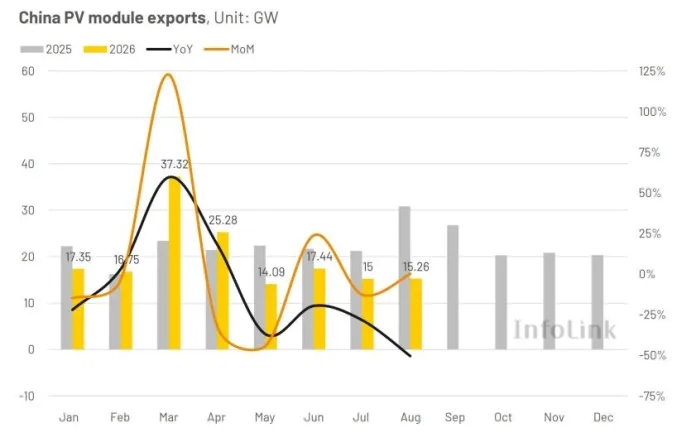
China's photovoltaic (PV) module exports remained broadly flat in August 2026, totaling approximately 15.26 GW, a marginal 0.2% increase month-on-month (MoM). Year-on-year (YoY), however, shipments fell 50% from 30.82 GW in August 2025, weighed down by a high comparison base and shifting demand patterns across major international markets.
India was a key contributor to the annual decline. Chinese module shipments to the country dropped sharply from 2.68 GW in August 2025 to just 0.07 GW in August 2026, following the introduction of domestic manufacturing requirements under the Approved List of Models and Manufacturers (ALMM) List-II. In the January–August period, cumulative module exports reached 158.71 GW, down 12% from the same period in 2025.
Solar cell exports climb 54% MoM
Despite the softer module picture, exports of solar cells recorded strong monthly growth, reaching 7.84 GW in August — up 54% from July. Cumulative cell exports for the first eight months of 2026 stood at 72.69 GW, a 9% increase YoY.
The surge was largely driven by manufacturers advancing deliveries ahead of anticipated US trade measures. Indonesia was the largest destination with 2.01 GW, followed by the Philippines (1.08 GW), Nigeria (0.75 GW), Kenya (0.72 GW) and Türkiye (0.59 GW), which continues to grow as a regional assembly hub. Indonesia, Laos and the Philippines together accounted for approximately 80% of the monthly increase in cell exports.
Suppliers reportedly accelerated shipments ahead of the expected implementation of US Section 232 Minimum Import Price (MIP) rules, which propose a price threshold of US$0.22 per watt and were scheduled to take effect on December 4. Yet the export window could narrow sooner than anticipated: anti-circumvention measures issued by the US Department of Commerce in late September are expected to slow shipments through October and November. Meanwhile, routes through India and Ethiopia have effectively closed because of domestic policy barriers and trade inquiries, prompting manufacturers to reconsider their supply-chain arrangements.
Europe remains the largest market
Europe continued to be the top destination for Chinese PV modules in August, taking 6.51 GW — roughly 43% of total exports — although volumes slipped 5% MoM and 48% YoY. The Netherlands remained the leading European buyer with 2.61 GW, while the UK recorded a 60% MoM increase to 0.43 GW, driven by distributors building inventory ahead of regulatory changes allowing self-installed balcony solar systems.
Asia-Pacific imports rise on policy shifts
Asia-Pacific imports climbed 10% MoM to 4.02 GW. Pakistan returned as the region's largest buyer with 0.93 GW, supported by energy policy changes favoring self-consumption and energy storage. Indonesia also strengthened activity following official plans to deploy 30 GW of solar capacity in 2026, supporting demand for imported equipment and influencing regional supply chains.
Americas post fastest growth; MEA face logistics headwinds
The Americas registered the fastest monthly growth among major regions, with Chinese module exports up 30% MoM to 2.19 GW. Brazil led imports with 0.92 GW, as developers accelerated shipments amid temporary reductions in tariff quotas.
Exports to the Middle East reached 1.63 GW, though shipments were hampered by higher war-risk shipping premiums around the Strait of Hormuz and the Red Sea, raising transportation costs and complicating logistics. Africa imported 0.91 GW in August, down 38% MoM amid port congestion in Durban and Lagos — yet remained the only region to record cumulative YoY growth, with volumes up 41%.